
In over three decades of teaching and working at the easel, I have found that studying the masterpieces of history is the ultimate foundation for any artist or collector. The techniques, struggles, and triumphs of past masters do not just belong in textbooks—they live on in every brushstroke applied in the studio today.
Whether I am demonstrating perspective to high school students or applying oil and watercolor to canvas in my Phoenix studio, the evolution of art history continues to inform my own traditional landscape paintings. I created the interactive presentation below as a visual journey through the 30 most famous works of art everyone should know. Click through the slides to explore the hidden details, the materials, and the enduring legacies of these incredible pieces.
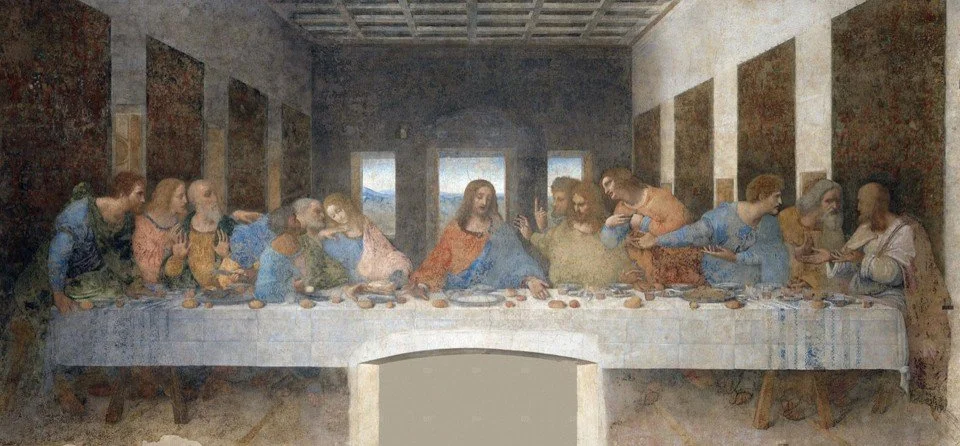
The Last Supper, Leonardo da Vinci (1495-1498)
The Evolution of the Easel: Understanding the Major Movements
The artworks in the presentation above span centuries of radical shifts in how humanity sees the world. To fully appreciate these 30 masterpieces, it helps to understand the foundational art movements they represent. Here is a brief guide to the eras that shaped modern painting:
The Renaissance (14th - 17th Century) A rebirth of classical learning and wisdom. Artists like Leonardo da Vinci and Michelangelo shifted away from flat, stylized medieval art, pioneering linear perspective, human anatomy, and naturalism to create works of profound balance and harmony.
The Baroque (1600 - 1750) Characterized by exaggerated motion, intense drama, and clear detail. Masters like Caravaggio and Rembrandt revolutionized the canvas using chiaroscuro—a striking interplay between deep, velvety shadows and brilliant light. Re-studying these specific Baroque oil techniques has been a major focus in my own recent studio work.
Neoclassicism (18th - Early 19th Century) A reaction against the frivolous, ornate styles of the era, Neoclassicism drew inspiration from the "classical" art and culture of Ancient Greece and Rome. Artists like Jacques-Louis David prioritized stark clarity, symmetry, and heroic subjects that emphasized civic duty and stoicism.
Impressionism (1860s - 1880s) A radical departure from the rigid rules of the academic art establishment. Impressionists like Claude Monet stepped out of the studio and into the light, using rapid, visible brushstrokes to capture the fleeting, sensory effect of a scene—the "impression" of a moment—rather than exact, realistic details.
Post-Impressionism (1880s - Early 20th Century) While they used the vibrant colors and thick application of paint developed by the Impressionists, artists like Vincent van Gogh and Paul Cézanne pushed further. They emphasized geometric forms, distorted forms for expressive effect, and used unnatural or arbitrary color to convey deeper emotional truths.
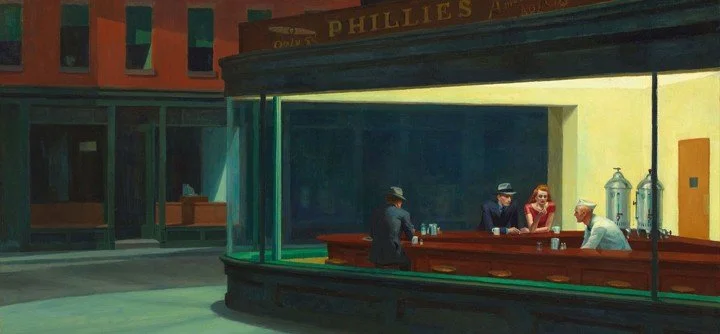
Night Hawks, Edward Hopper (1942)
Modernism (Late 19th - Mid 20th Century) Not a single style, but a broad, global movement where artists deliberately rejected historical, conservative values. Modernists sought new ways of seeing and thinking about the materials of art itself, experimenting with form, color, and process to reflect the rapid industrialization of society.
Cubism (Early 20th Century) Pioneered by Pablo Picasso and Georges Braque, Cubism shattered traditional perspective. Instead of depicting objects from a single viewpoint, subjects were broken up, analyzed, and reassembled in abstracted forms, showing multiple angles simultaneously on a flat canvas.
Abstract Expressionism (1940s - 1950s) The first specifically American movement to achieve international influence, placing New York City at the center of the Western art world. Artists like Jackson Pollock focused on spontaneous, automatic, or subconscious creation, prioritizing the physical act of painting itself over recognizable subjects.
Pop Art (1950s - 1960s) A movement that blurred the boundaries between "high" art and "low" culture. Artists like Andy Warhol and Roy Lichtenstein drew inspiration from commercial and popular culture—advertising, comic books, and mundane cultural objects—challenging the traditions of fine art with irony and bold, graphic aesthetics.
30 Most Famous Works of Art List
1. MONA LISA, LEONARDO DA VINCI (1503-1506) RENAISSANCE
2. DAVID, MICHELANGELO (1501-1504) RENAISSANCE
3. SCHOOL OF ATHENS, RAPHAEL (1509-1511) RENAISSANCE
4. THE CREATION, MICHELANGELO (1508-1512) RENAISSANCE
5. THE LAST SUPPER, LEONARDO DA VINCI (1495) RENAISSANCE
6, THE BIRTH OF VENUS, BOTTICELLI (1484-5) RENAISSANCE
7. SUPPER AT EMMAUS, CARAVAGGIO (1601) BAROQUE
8. LAS MENINAS, VELAZQUEZ (1556) BAROQUE
9. GIRL WITH PEARL EARRING, VERMEER (1665) BAROQUE
10. SELF PORTRAIT, REMBRANDT (1669) BAROQUE
11. OATH OF THE HORATII, JACQUES LOUIS DAVID (1784) NEOCLASSICAL
12. THE GREAT WAVE OF KANAGAWA, HOKUSAI (1830-32) JAPANESE
13. THE THINKER, RODIN (1880) MODERN OR IMPRESSIONISM
14. WATER-LILLY POND, MONET (1920) IMPRESSIONISM
15. BASKET OF APPLES BY CEZANNE (1895)
16. STARRY NIGHT, VINCENT VAN GOGH (1889) POST-IMPRESSIONISM
17. SUNDAY AFTERNOON ON THE ISLAND OF LA GRANDE JATTE, GEORGES SEURAT(1884-6) POST IMPRESSIONISM /POINTILLISM
18. THE SCREAM, EDVARD MUNCH (1893) MODERN
19. THE KISS, GUSTAVE KLIMT (1907) MODERN
20. WOMAN WITH A GUITAR, GEORGES BRAQUE (1913) CUBISM
21. COMPOSITION VII, KANDINSKY (1913) MODERN
22. AMERICAN GOTHIC, GRANT WOOD (1930) MODERN
23. COW'S SKULL RED, WHITE, & BLUE, GEORGIA O'KEEFFE (1931) MODERN
24. PERSISTENCE OF MEMORY, SALVADOR DALI (1931) SURREALISM
25. THE FLOWER CARRIER, DIEGO RIVERA (1935) MODERN
26. GUERNICA. PABLO PICASSO (1937) MODERN (CUBISM)
27. NIGHTHAWKS, EDWARD HOPPER (1942) MODERN
28. CHRISTINA'S WORLD, ANDREW WYETH (1948) MODERN
29. LAVENDER MIST, POLLOCK (1950) ABSTRACT EXPRESSIONISM
30. CAMPBELL'S SOUP CANS, ANDY WARHOL (1962) MODERN (POP ART)
From the Masters to the Modern Studio Studying these historical movements isn't just an academic exercise—it is the foundation of my daily studio practice. From the dramatic lighting of the Baroque masters to the expressive brushwork of the Impressionists, these classical techniques live on in my work today. I invite you to explore how these centuries-old traditions translate into contemporary fine art.
