
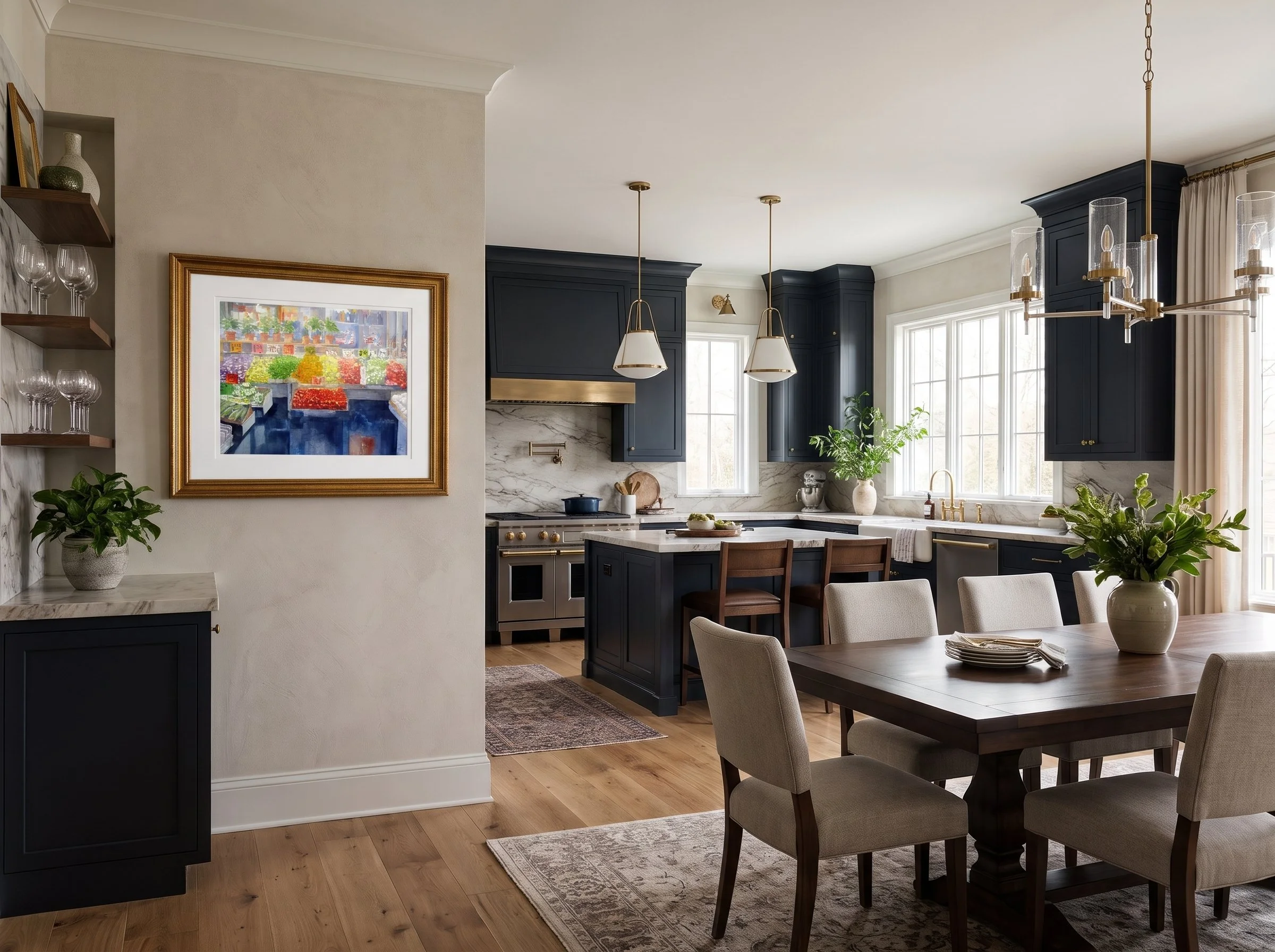
Modern kitchen decor with wall art by Bruce Black. Market Bounty (watercolor, 17 × 20)
Original artwork is often the soul of a well-designed room. It elevates a space, provides a focal point, and gives a home its unique character. However, while interior designers love sourcing original fine art, they often dread the process of working with artists.
Why? Because the creative process frequently clashes with the strict business operations of an interior design firm.
If you want to get your artwork into high-end homes and build lasting relationships with designers, you have to understand their pain points and eliminate them. Here are the biggest complaints interior designers have about working with artists—and the exact steps you can take to become a designer’s dream collaborator.
The 5 Biggest Complaints Designers Have About Artists
1. Lack of Professional Presentation Assets Designers don't just buy art; they have to pitch your art to their clients. If you only provide low-resolution Instagram grabs, or if you force the designer to hunt through your website for exact dimensions and mediums, they can't effectively sell your work. They need polished, ready-to-present assets.
2. The Trade Pricing Disconnect Interior designers run businesses with tight margins, relying on industry trade discounts (typically 15% to 20% off retail) to make sourcing profitable. Artists who demand strict retail pricing, refuse to negotiate, or lack a formal trade program often price themselves out of a designer’s budget.
3. Unreliable Communication and Logistics Design projects operate on strict timelines involving multiple contractors, deliveries, and a highly anticipated "install day." An artist who is slow to reply, misses shipping deadlines, or ships a canvas without proper D-rings and hanging wire can delay an entire room reveal.
4. Friction During Custom Commissions When an available piece is the wrong scale, designers turn to custom commissions. This turns into a major headache if the artist struggles to take creative direction, becomes defensive over a requested color palette, or strays too far from the agreed-upon aesthetic that the client has already approved.
5. Introverted artists Occasionally, an art director or Interior designer may want to bring customers to an artist’s studio or have some other interaction between the client and the artist. The designers need their artists to be professional and outgoing when this occurs. Artists need to be dressed appropriately and engage with the clients in a warm way that cements the sale and supports the buyer’s trust in their designer. Designers get frustrated when artists are not available or come across as unprofessional and unable to help foster those relationships.
How to Gain a Designer’s Attention (and Keep It)
Building a trade program is only half the battle. You also have to get your work in front of interior designers and prove that you are a reliable, long-term partner. Here is how to bridge the gap between the studio and the design firm.
Optimize for Mood Boards Designers do not browse art the way a casual gallery patron does; they search by aesthetic, color palette, and room concept. Make it easy for them to pull your work into their initial mood boards. Curating specific Pinterest boards—such as "Fine Art for Coastal Interiors" or "Southwestern Tonalist Landscapes"—puts your work directly in the path of a designer searching for a specific project vibe.
Use Highly Targeted Search Tags When a designer is hunting for a specific piece to finish a room, they use precise search terms. A scattershot approach to social media will bury your work. Instead of using dozens of generic tags on an Instagram post, limit your hashtags to 3 to 5 highly specific, targeted terms (e.g., #southwesternlandscape #tonalistoil #contemporaryimpressionism) so the right professionals can actually find you.
Get on Their Local Radar Designers love sourcing local talent to give their projects an authentic, regional grounding. Do not just rely on global platforms. Actively maintain your presence on vetted local and regional art directories—like Artlink or Artinerary—where local design firms frequently scout for fresh, professional talent for their high-end residential builds.
Be a Frictionless Problem Solver Once a designer reaches out, your job is to make their life easier. If they need a piece held for 48 hours to get client approval, accommodate them. If they need a custom commission because your 16"x20" watercolor is perfect but the wall requires a 24"x36", be open to the collaboration. When you prove that you communicate clearly, meet deadlines, and deliver artwork that arrives ready to install, a designer won't just buy from you once—they will keep you in their permanent sourcing rolodex.
Ultimately, bridging the gap between the fine art studio and the interior design firm comes down to one thing: making the process effortless. For artists, taking the time to build tear sheets, establish clear trade pricing, and communicate like a business owner isn't just about selling a single painting—it is about becoming a trusted, long-term partner in a designer's creative vision. When you treat your art practice with the same operational rigor that a designer applies to their projects, the friction disappears, leaving only the artwork to speak for itself.

Southwest decor with wall art by Bruce Black. Verde Valley (watercolor, 18” X 24”)
How to Create a Professional Tear Sheet For Designers
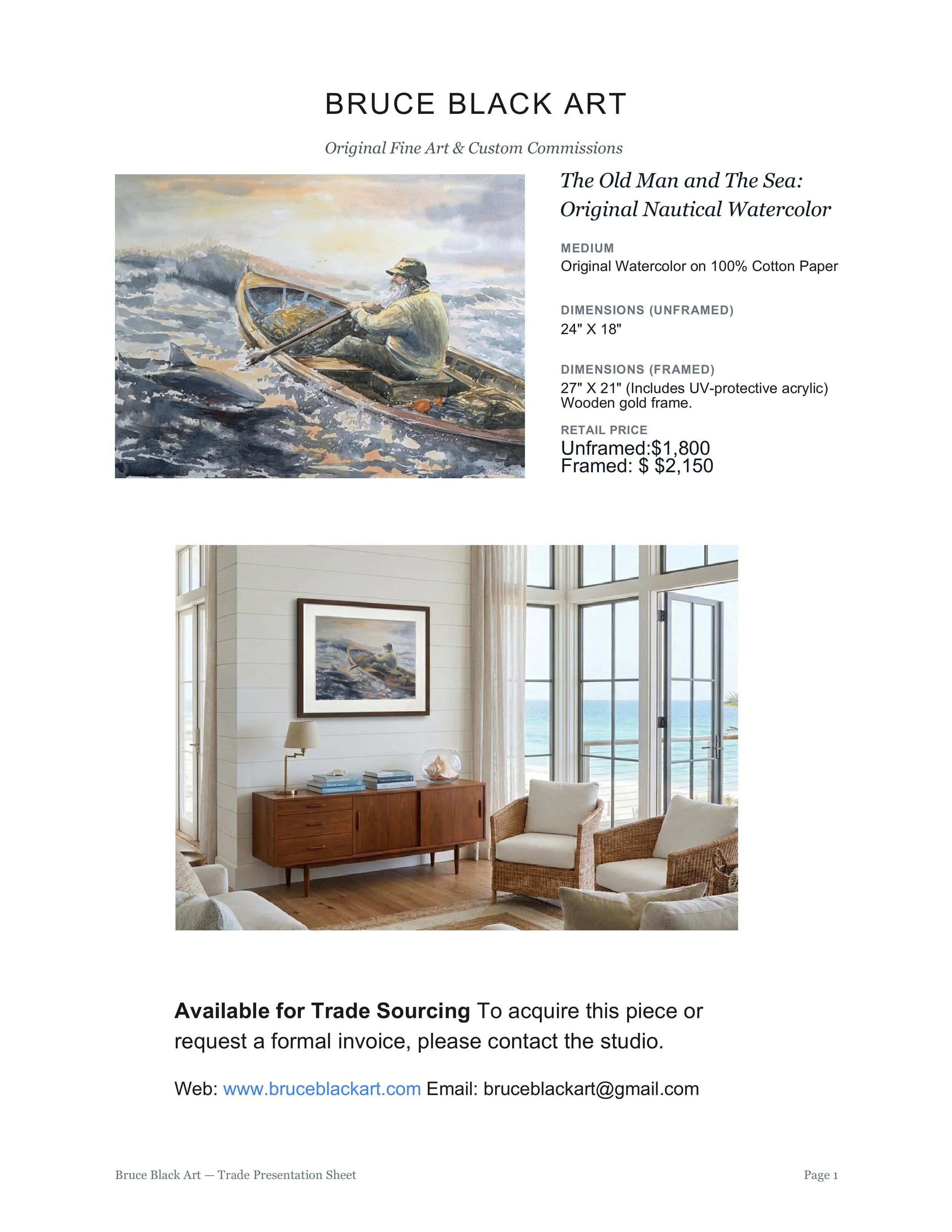
A tear sheet is essentially a resume for a single piece of artwork. Designers need these single-page PDFs so they can drop them directly into their client presentation decks. Making this easy for them instantly sets you apart.
Here is what you should include on every tear sheet:
The Hero Image: A pristine, well-lit, high-resolution photograph of the piece on a clean white background.
The Scale Image: Show the piece framed. If you paint traditional oils or watercolors, designers need to see the physical object—whether that’s a clean white mat with a wooden gold frame, or an oil painting with a small linen liner.
The Specifications:
Title: (e.g., Farmers Market)
Medium: Be highly specific (e.g., Original Watercolor on 100% Cotton Paper, or Traditional Oil on Canvas).
Dimensions: List both the unframed and framed footprint (e.g., 16"x20" Unframed / 18"x24" Framed).
Retail Pricing: Always list the public retail price clearly (e.g., $1,700). Note: Do not list your trade discount on this sheet, as the designer will show this document directly to their client.
Contact Info: Your name, email, and a direct hyperlink to the artwork’s page on your website.
How to Structure a Professional Trade Program
To attract designers, you need a formalized trade program clearly outlined on your website. Here is how to set it up:
Establish Consistent Retail Pricing Your retail pricing must be identical across all channels. A designer’s worst nightmare is having their client find the exact same piece on your website for less money. Maintain strict, predictable tiers (for example, $850 for unframed watercolors, $425–$950 for smaller oils, and $2,300 for large framed pieces).
Calculate Your Trade Margins Offer the industry standard: a flat 15% to 20% trade discount. Determine your take-home pay before publishing this. If your retail benchmark for a framed 16"x20" watercolor is $1,700, a 20% trade discount brings the designer's cost down to $1,360, allowing them room to make their margin.
Define Your Terms & Logistics Create a dedicated "Trade Program" page on your site detailing your logistics. Specify your framing and archival standards (such as UV-protective acrylic and professional backing). Clearly state your lead times for shipping and whether you offer local delivery for nearby projects.
Require an Application Don't offer trade pricing to just anyone. Require designers to submit their business name, website, and a valid interior design credential (like an ASID membership or a resale certificate) to qualify. This shows you respect their profession and run a legitimate business yourself.
Example Trade Sheet
Listing Artist’s Artwork For Designers
Are you an interior designer looking for traditional Southwestern landscapes, coastal vistas, or elegant still life paintings that arrive ready to install? Click HERE and gain access to exclusive pricing and presentation-ready tear sheets.
